

Fleet Tire Management: How AI and Tire Analytics Are Changing the Way Fleets Manage Tire Costs
Effective fleet tire management has always been critical to controlling operating costs. Tires represent a significant expense for commercial fleets, yet many organizations still rely on inspections, spreadsheets, historical reports, and technician experience to understand why tires are being removed from service.
The problem is that traditional fleet tire management often tells you what happened—but not necessarily why it happened or what you should do next.
What if every tire coming off a fleet could become a source of intelligence?
That is the idea behind Fleet Tire Intelligence, a new technology developed by Atrium that combines our proprietary tire analysis database, our own code, and artificial intelligence to analyze tires as they come out of service.
The objective is simple: transform tire removals into actionable fleet analytics that help fleets improve maintenance, address driver-related issues, identify potential warranty opportunities, and ultimately reduce fleet tire costs.
Fleet Tire Management Starts With Understanding Why Tires Are Removed
Every tire removed from service tells a story.
Irregular wear, sidewall damage, punctures, impact damage, run-flat conditions, inflation-related damage, and mechanical wear patterns can all provide valuable clues about what is happening within a fleet.
Historically, much of this information has been difficult to capture and analyze consistently. Valuable information can remain buried inside inspection reports, photographs, spreadsheets, or individual technician observations.
Fleet Tire Intelligence changes that.
Using our proprietary tire analysis database combined with AI tire analysis, tire images and inspection information can be evaluated to identify tire conditions and potential causes.
Instead of simply recording that another tire was replaced, fleets can begin understanding why their tires are coming out of service.
That is an important shift in fleet tire management.
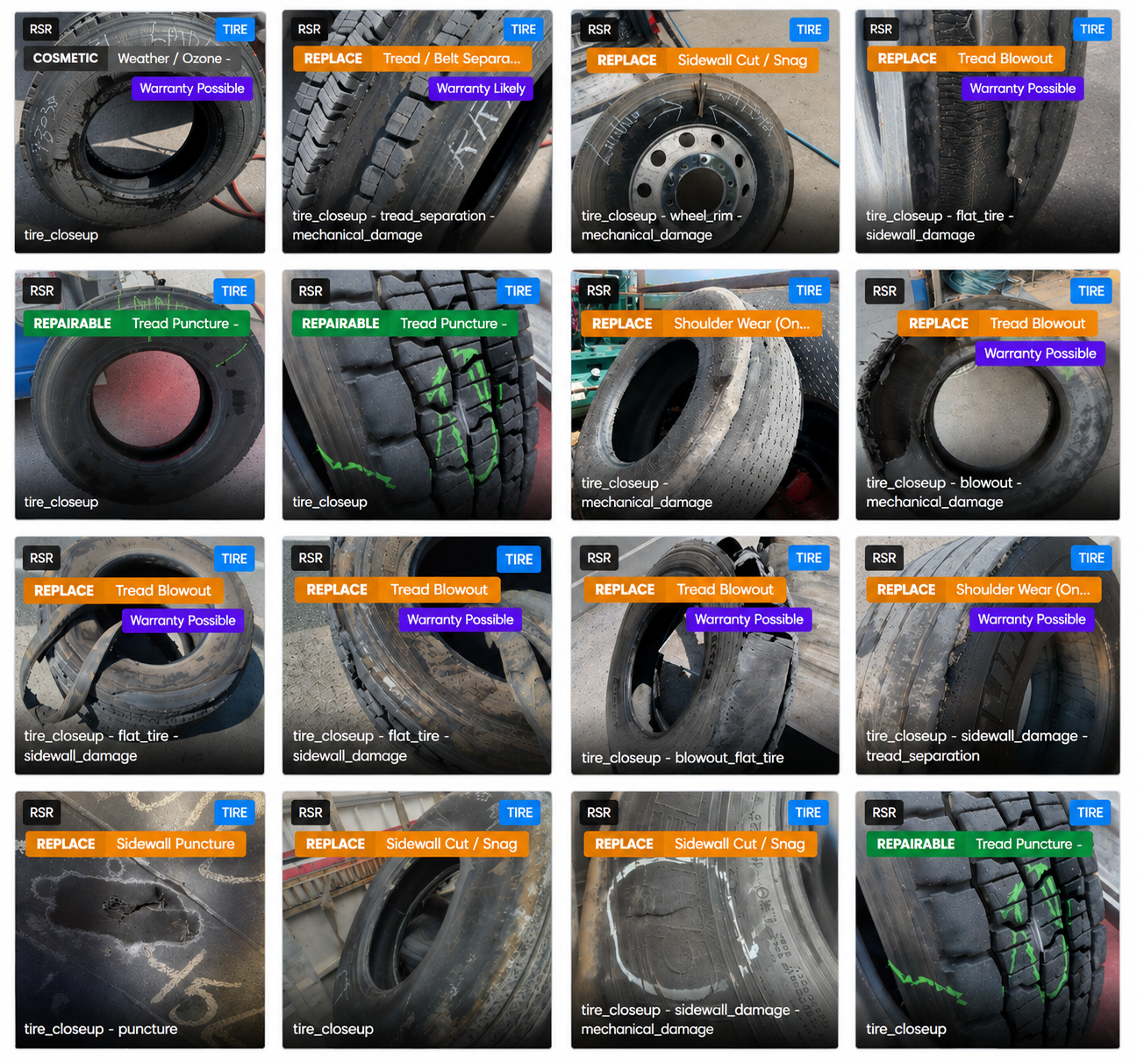
Turning Tire Wear Analysis Into Action
Collecting more tire data isn’t the objective.
Taking action is.
Through tire wear analysis, fleets can identify patterns that may otherwise be difficult to recognize across hundreds or thousands of tire removals.
For example, repeated irregular wear could indicate potential alignment, suspension, inflation, or other maintenance issues.
A high frequency of sidewall cuts, impacts, or curb damage could identify an opportunity for targeted driver education.
Tires consistently being removed too late could indicate an opportunity to adjust inspection or removal practices to protect casing value and improve retread potential.
Potential manufacturer or retread-related conditions could also be identified for further warranty review.
This is where commercial fleet tire analytics become valuable: turning individual tire observations into fleet-wide trends that management can act on.
Using Tire Maintenance Analytics to Find Problems Earlier
Traditional fleet tire reporting is often historical. By the time a trend is discovered, the fleet may have already experienced additional tire replacements, lost casings, roadside failures, and unnecessary costs.
Fleet Tire Intelligence is designed to bring that information closer to the actual tire removal.
Real-time insights combined with frequent management reports allow fleets to identify developing trends and use tire maintenance analytics to determine where corrective action may be required.
Instead of waiting for an annual tire review, fleets can continuously evaluate tire performance and emerging issues.
That turns fleet tire management from a reporting exercise into a continuous improvement process.
Connecting Maintenance, Driver Behaviour and Warranty Opportunities
One of the most difficult questions in commercial tire management is also one of the most important:
What is actually driving our tire costs?
Is it maintenance?
Is it driver behaviour?
Is it the operating environment?
Are tires being removed at the wrong time?
Or are potential warranty opportunities being missed?
Fleet Tire Intelligence helps categorize and quantify these conditions.
Maintenance teams can investigate recurring inflation, alignment, suspension, and mechanical wear patterns.
Operations and safety teams can identify preventable driver-related damage such as curb impacts, sidewall cuts, impact damage, and other avoidable incidents.
Fleet and procurement teams can identify potential warranty candidates that may otherwise go unnoticed.
Bringing these areas together creates a new level of commercial tire intelligence.
How Better Fleet Tire Management Can Reduce Tire Costs
The purchase price of a tire represents only part of its true cost.
Premature removal, irregular wear, improper inflation, roadside service, lost casings, driver damage, and missed warranty opportunities can all increase a fleet’s overall tire expense.
The challenge is determining which issues are occurring most frequently—and which ones represent the greatest opportunity for improvement.
That’s where commercial fleet tire analytics can fundamentally change fleet tire management.
Rather than relying on assumptions, fleets can use their actual tire removal data to identify patterns and prioritize their efforts.
If 25% of premature tire removals are associated with preventable sidewall or impact damage, that creates a specific driver-training opportunity.
If irregular wear is concentrated within certain equipment, terminals, or wheel positions, maintenance teams know where to investigate.
If potentially warrantable conditions repeatedly go unidentified, management can improve the warranty recovery process.
The goal isn’t simply to collect information. It’s to use that information to reduce fleet tire costs.
From Fleet Tire Reporting to Actionable Fleet Analytics
Every fleet operates differently.
Routes, equipment, loads, geography, maintenance practices, terminals, and drivers all influence tire performance.
That’s why effective fleet tire reporting should go beyond simply counting replacements.
Fleet Tire Intelligence creates an evolving picture of what is happening across the fleet. As more tires are analyzed, management can identify recurring conditions, prioritize opportunities, implement corrective actions, and then measure whether those actions are working.
For example:
Identify → Analyze → Act → Measure → Improve
A fleet identifies excessive sidewall damage, implements targeted driver training, and then measures future tire removals to determine whether that condition declines.
That is actionable fleet analytics.
Fleet Tire Management Is Becoming Fleet Tire Intelligence
The future of fleet tire management isn’t simply tracking which tires are installed on which vehicles.
It’s understanding why tires are coming off.
Fleet managers should be able to answer:
Why are our tires wearing out prematurely?
Which tire conditions are costing us the most money?
Are we experiencing recurring maintenance issues?
How much tire damage may be driver-related and preventable?
Are we maximizing casing and retread opportunities?
Are we missing potential warranties?
Which locations, vehicles, or operating conditions require attention?
And most importantly:
What should we do about it?
By combining Atrium’s proprietary tire analysis database, our own code, AI tire analysis, tire wear analysis, and real-time tire maintenance analytics, Fleet Tire Intelligence is designed to answer those questions.
Don’t just track the tires going onto your fleet. Learn from every tire coming off your fleet.
That’s the evolution from traditional fleet tire management to Fleet Tire Intelligence.
Book a demo to learn more!